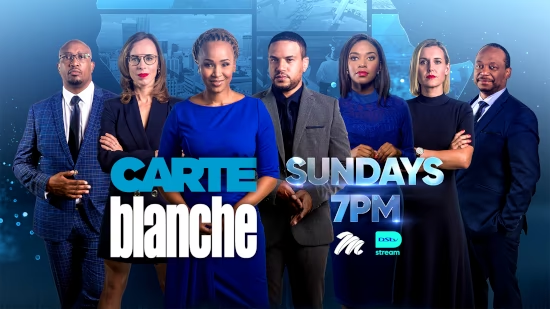
“This Sunday, we depart from our usual format to discuss an issue at the centre of much of our recent reporting: whether we’ve become a mafia state. It’s a question other media colleagues have debated for some time, but our investigations into how criminal elements have infiltrated the state mean we’re able to provide important insights.” – John Webb, Executive Producer
Mafia State
High-profile murders, justice for sale, cases stalled and whistleblowers targeted. Multibillion-rand projects held hostage and communities caught in the crossfire. From construction to transport, the courts to the centre of government, organised crime infiltrates every institution. And now, revelations at the Madlanga Commission of Inquiry into Criminality, Political Interference, and Corruption in the Criminal Justice System are unravelling the power struggles at the very heart of law enforcement. So, is South Africa a mafia state? In this special episode, we return to past investigations into corruption, compromised institutions, and criminal syndicates. Live in-studio with veteran journalists and Carte Blanche producers, we discuss power corrupted, accountability undermined and public trust eroded. Can a rising tide of violence, intimidation and silence be stemmed?
Producers: Stenette Grosskopf & Lourensa Eckard
Presenters: Lourensa Eckard & Govan Whittles
SEE IT ALL
Murray Murders
A brutal double murder – a family shattered. Two years ago, father-and-son liquidators Cloete and Thomas Murray were gunned down in Johannesburg. And while their devastated family have been promised justice, nearly three years have passed without arrests or answers. The Murrays were working on a string of high-profile and controversial liquidation cases, bringing them into contact with the world of organised crime. But why has the investigation into their murders apparently been repeatedly bungled?
In Plain Sight
In July, an explosive press conference uncovered a nest of intrigue in our country’s law enforcement. Allegations of political interference in crime investigation, of connections between senior officials, lawmakers and powerful drug cartels. Of corruption on a vast scale. And one man emerged heroic: KwaZulu-Natal Police Commissioner, Lieutenant General Nhlanhla Mkhwanazi. But was the July press conference just another domino in an unfolding game? One in which you’re going to be told who and what to believe. It’s an atmosphere in which asking critical questions often results in a public backlash. But everything you’re about to hear is backed by documentary evidence and conversations with high-level sources. The overriding question is: in this flurry of suspensions and investigations, who is telling the truth?
Crossfire or Cover-Up?
Imagine driving home with your family at night and suddenly finding yourself in the middle of a shootout. That’s what happened to the Ismail family five years ago. They were told they were caught in a crossfire, but the evidence raises more questions than answers. Despite a stalled investigation, the family hasn’t given up their quest for justice and continues to ask questions of the very people whose job it is to protect us.
Kidnapping Crisis
Since 2022, foreign nationals – especially Ethiopian businessmen – have been targeted by kidnappers in the Eastern Cape. Now it’s become an all-out war. In Qonce (formerly King William’s Town), the community says at least two people are taken every week, with the kidnappers demanding ransom from their families. On the ground, informants and security experts say they’ve narrowed down the location of the kidnapping kingpins. They say that organised crime syndicates have taken root in the province and allege that police are involved. According to some insiders, these small-scale kidnappings provide much-needed capital for the syndicates to operate on a larger, more lucrative scale; targeting wealthy South African business owners.
NPA: Tell No Lies, Claim No Easy Victories
In 2019, Shamila Batohi returned from The Hague to lead our National Prosecuting Authority (NPA). During the Zuma presidency, the once-proud NPA had been hollowed out by state capture; Batohi was a welcome appointment who promised to restore the organisation and ensure speedy convictions of state capture perpetrators. The same year, former prosecutor Hermione Cronje returned to head up the NPA’s sharp end: the Investigating Directorate (ID) which would investigate, arrest and prosecute state capture and complex financial crimes. Batohi and Cronje: two powerful women with the same aim. But within two years, Cronje left for a second time. Since then, the NPA has made several high-profile arrests, but the progress on state capture cases is dismal, and crucial ones have been struck from the roll. Is the NPA still in crisis, despite angry denials from current leadership? Carte Blanche, in association with amaBhungane, looks at what has gone wrong at the National Prosecuting Authority.
Terrorised by Taxis
It’s a never-ending battle: taxi operators versus motorists. Recently, in some parts of Gauteng, taxi associations were shifting gears and redirecting their anger at motorists who shared rides with their colleagues, friends or family. As they battled to maintain an iron grip on the public transport market, taxi operators said that carpooling and lift clubs were impacting their bottom line, robbing them of potential clients. And, as the threats escalated, all motorists with more than one passenger in their vehicle became targets.
KZN Police Fightback
In KwaZulu-Natal, shootouts between police and gun-wielding criminals have become the norm. Between January and September 2024, close to 100 criminal suspects were killed by police in running gun battles. KZN isn’t the province with the highest or even the second-highest levels of violent crime in the country, but its police had become notorious for “fighting fire with fire”. At the centre of it all was the province’s top brass, led by the provincial Police Commissioner Lt. Gen. Nhlanhla Mkhwanazi who insisted that police were at war with criminals intent on bloodshed. But was this approach justified? In a wide-ranging interview, Carte Blanche sat down with Mkhwanazi to ask the hard questions around the emergence of a police force.
Trailer (age restricted)
Critical Care Under Threat
The Carte Blanche Making a Difference Trust has built a haven for children in crisis at Sebokeng Hospital. This dedicated new paediatric trauma unit has revolutionised the care of babies and older children. But building it was not without difficulties. Earlier, the so-called construction mafia threatened to derail the build, forcing the Trust to ramp up security and fight back against attempts to sabotage this critical project. But with the support of hospital management and the dedication of its team, the Carte Blanche Making a Difference Trust ensured that this life-saving facility became a reality for Sebokeng’s youngest and most vulnerable patients.
Lethal Targets
In July last year, Coreth Naudé – a well-known senior advocate working for SARS on several high-profile cases – was shot multiple times in Durban. Naudé had arrived at her hotel parking lot in Durban North when two gunmen opened fire, wounding her three times in the upper body, neck and face: all in broad daylight. This brazen assassination attempt was just one in a long line of hits on prominent investigators: detectives, liquidators, and even city officials. Powerful suspects are no longer simply silencing whistleblowers, but setting their sights on investigators as well and threatening the rule of law.
Revisit the Story (age restricted)
Extortion City
On the surface, Randolf Jorberg – with his bright yellow t-shirt, sunglasses, and newly-dyed yellow beard – is an eccentric character. But on the streets of Cape Town, he is a well-known business owner who had run one of the best beer houses on Long Street. In recent years, though, Randolf had been forced to retreat from the spotlight as protection rackets targeting small businesses had flourished. Cape Town had become the extortion epicentre, with violent criminal syndicates operating across the city. In 2015, Randolf had refused to pay protection money. Weeks later, his doorman was assassinated. He said it was a clear message: pay up or suffer the consequences. While alleged underworld kingpins were on trial in the Western Cape High Court, their henchmen continued wreaking havoc. Carte Blanche examined the underbelly of the Western Cape’s deadly extortion rackets.
Get the Full Story (age restricted)
STREAMING NOW
Forgotten Schools
In the far-flung villages of rural KwaZulu-Natal, thousands of disabled children are dependent on just a few dozen special needs schools. For many, those schools are the only point of access not only to education, but to therapy and even regular meals. But that lifeline is fraying; inadequate facilities, a shortage of specially trained staff, promises of infrastructure that never materialised. And now, the government subsidies these schools depend on arrive months late or not at all. Parents and teachers are at breaking point, and some are taking drastic steps. Watch the full story now on DStv Stream and Catch Up.
COMING SOON
Classical Revolution
The voices: world-class. The talent: undeniable. But can an authentic South African sound find a place in the concert halls of Europe? That’s in an upcoming episode of Carte Blanche.
JOIN THE #CARTEBLANCHE CONVERSATION
Please note: Carte Blanche line-ups are subject to change. Stories can be viewed at www.carteblanche.co.za
Facebook: Carte Blanche #CarteBlanche
Bluesky: @carteblanche.co.za
TikTok: @carteblanchetv101
Youtube: carteblancheTV #CarteBlanche
Instagram: @carteblanchetv #CarteBlanche
Twitter / X: @carteblanchetv
Threads: carteblanchetv
